Comic books and the escapism they offer do not exist in a vacuum, sealed off from real-world events. 1974 is a perfect example of how the culture outside the spinner rack seeps directly into the stories on it.
Watergate and the fall of Richard Nixon dominated the year, eroding public trust in the U.S. government and leaving the nation questioning its institutions. Out of that environment of political cynicism emerged the rise of the anti-hero. Within a single twelve-month stretch, readers met Wolverine, the Punisher, Nomad, and Deathlok — four characters who embodied America’s growing appetite for grit, moral ambiguity, and rebellion.
Meanwhile, the Arab Oil Embargo (October 1973–March 1974) reshaped everyday life. Long gas lines, rationing, and soaring inflation became part of the national landscape. Oil prices quadrupled in just five months, and the ripple effects touched everything — including comic books. The era of the cheap, disposable comic was coming to an end. In 1970, a typical issue cost 15 cents; by 1976, it had doubled to 30 cents. Before the Bronze Age closed in 1984, it would double again to 60 cents.
Publishers scrambled to adapt. In 1974 alone, Marvel launched nine separate Giant-Size titles—books with higher page counts and higher cover prices. DC responded with its line of 100-Page Giants, expanding page counts across its core titles. Both approaches acknowledged a simple reality: the economics of comics were changing just as dramatically as the characters who populated them.
What follows is a list of the 25 most valuable comic books from 1974—an era-defining mix of first appearances, second appearances, and unforgettable confrontations.
1. Incredible Hulk #181 –
1st full appearance of Wolverine. Herb Trimpe delivers a fantastic cover featuring the iconic fight between Hulk and Wolverine—sorry, Wendigo, you’re barely a footnote here. And is it just me, or does Wendigo look like an old man yelling at neighborhood kids to get off his lawn? This comic is so iconic that anyone who has even heard of Wolverine or seen an X-Men movie will recognize it. What they won’t immediately know is to look for the Shanna the She-Devil Marvel Value Stamp tucked inside.
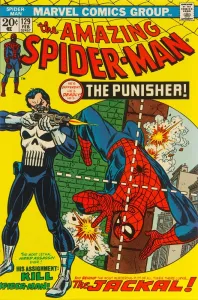
2. Amazing Spider-Man #129 –
1st appearance of the Punisher. The brilliance of this bright yellow cover isn’t just the color—it’s the layout. We’re seeing Spider-Man from the Punisher’s point of view while simultaneously seeing Punisher from another angle. Notice how the Punisher breaks outside the panel border, just like his persona breaks outside traditional hero morals. Gil Kane absolutely dominated 1973 and 1974, creating first-appearance covers for Blade, Ghost Rider, Red Sonja, Howard the Duck, Punisher, and Iron Fist. This one might be his most recognizable work.
3. Incredible Hulk #180 –
1st Wolverine cameo appearance (full splash page). The final page of Hulk #180 is arguably the greatest cameo in all of comicdom. Had Wolverine appeared in any additional panels, this might have been considered his full first appearance, but by the strict rules of cameo vs. first appearance, this one lands firmly in “cameo” territory. Herb Trimpe handled the cover and interior art for this now-eternal Bronze Age key.
4. Marvel Premiere #15 –
1st appearance of Iron Fist. Martial arts films peaked in popularity in 1973 and 1974, so Iron Fist’s debut couldn’t have been timed better. Gil Kane draws Iron Fist, splattering three attackers and a streetlamp in a single move. Is it believable? Not really. Is it crazy cool? Absolutely.
5. Amazing Spider-Man #135 –
2nd appearance of the Punisher. I love the creativity of John Romita Sr., who divided this cover into segments by using a spider. It’s like a soap opera for Spider-Man, and the key figure is the one with the epic eyebrows and a gun.
6. Incredible Hulk #182 –
2nd appearance of Wolverine. The trifecta of key Wolverine issues wraps up with #182. All three issues—#180, #181, and #182—include a Marvel Value Stamp, which keeps collectors on their toes. From a value and historical standpoint, this is a must-own Bronze Age key. Artistically, though, it’s a mixed bag: a tiny man hoisting Hulk, a Hammer whose head looks too small, and a Hulk with a neck twisted just a little too far. Still, whatever its quirks, it unquestionably belongs in every Wolverine fan’s collection.
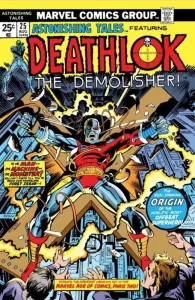
7. Astonishing Tales #25 –
1st appearance of Deathlok. Rich Buckler’s cover gives Deathlok a Frankenstein vibe as electricity crackles around him in his grim resurrection scene. Equally important: this issue contains George Pérez’s first paid comic book work—just two pages, but that spark ignited one of the most monumental careers in comics.
8. Giant-Size Chillers #1 –
1st appearance of Lillith. The first of five Giant-Size books to make this list, and with good reason. John Romita Sr. sets a muted, gothic backdrop and places Dracula and his daughter squarely in the spotlight. Giant-Size books are notoriously tough in high grade: tight boxing shifts the spine, and the added thickness often causes bottom-spine rips. According to the CGC census, only 48 copies have ever been graded 9.8. A frighteningly low number for such an important Bronze horror key.
9. Doctor Strange #1 –
1st appearance of the Silver Dagger. CGC has graded 211 copies at 9.8 and another 351 at 9.6, proving that collectors care deeply about this issue. Frank Brunner knew exactly how to craft a Doctor Strange cover—freaky, surreal, and just a little unsettling. I’m not sure what that skull-octopus creature with claws is supposed to be, but that’s the whole point. Strange deals in forces we can’t understand, so his covers should look like beautiful nightmares.
10. Savage Sword of Conan #1 –
1st issue in a new series. Because Curtis Magazines didn’t need Comics Code Authority approval, Savage Sword could push boundaries with more violence, more intensity, and more “Conan being Conan,” including rescuing barely-clad women and dismantling his enemies. The painted cover by Boris Vallejo is a masterwork from one of fantasy art’s most underappreciated giants.
11. Amazing Spider-Man #136 –
1st appearance of the 2nd Green Goblin (Harry Osborn). This is the moment Harry Osborn steps out of his father’s shadow and brings back one of Spider-Man’s greatest sources of pain. The cover, drawn by John Romita Sr., captures that emotional turmoil beautifully—friends turned foes, loyalty turned to rage. It’s a key turning point in the ongoing Spider-Man saga and a powerful reminder that the Goblin legacy doesn’t rest easy.
12. Captain Marvel #33 –
Origin of Thanos. Long before Jim Starlin wrote Infinity Gauntlet in 1991, he was already shaping the destiny of the Mad Titan. Starlin handled both the cover and interior art for this issue, which expands Thanos’ backstory and hints at the cosmic epic to come. The cover—Thanos gripping Captain Marvel by the head and dangling him off a rooftop—is pure Bronze Age drama in the best way.
13. Captain America #180 –
1st appearance of Nomad (Steve Rogers). How deep was America’s disillusionment after Watergate? Steve Rogers threw away the star-spangled Captain America suit for the black Nomad suit because he didn’t want to be associated with America. In this issue, Steve uncovers corruption that hints at reaching all the way to the Oval Office—a storyline mirroring real-world events with surprising boldness for 1974.
14. Tomb of Dracula #18 –
1st battle between Dracula and Werewolf by Night Part 1. Comic fans have always loved a good showdown—Thor vs. Hulk, Hulk vs. Thing, Superman vs. Muhammad Ali. Dracula vs. the Werewolf fits right into that tradition of monster-meets-monster spectacle. Although the two have clashed plenty on the big screen, this is their first confrontation in comics, setting the stage for one of the most memorable horror crossovers of the Bronze Age.
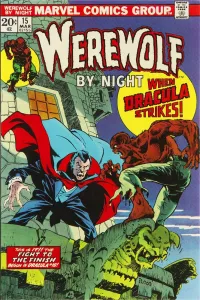
15. Werewolf by Night #15 –
1st battle between Dracula and Werewolf by Night Part 2. Mike Ploog delivers one of his finest covers here: an ancient castle with looming gargoyles, Dracula’s magnificent cape, and a werewolf ready to tear into him with feral intensity. The castle’s unusual green hue feels strange at first glance, but it actually pulls your attention toward the central conflict. Ploog created some of the best horror covers of the era—Marvel Spotlight, Werewolf by Night, Monster of Frankenstein—and this one ranks right up there.
16. Deadly Hands of Kung Fu #1 –
1st appearance of the Sons of the Tiger. Bruce Lee passed away in the summer of 1973, and less than a year later, this martial arts magazine arrived—perfectly timed for the kung-fu wave sweeping America. Neal Adams delivers a powerful, cinematic cover featuring a Bruce Lee–inspired figure striking with impossible precision while chaos erupts behind him. As both a cultural artifact and a key Bronze martial arts debut, this issue is pure 1974 energy.
17. House of Secrets #123 –
Frank Robbins Horror Cover. Frank Robbins only drew one cover for House of Secrets, but he made it count. The image juxtaposes the sweet innocence of an ice cream cone with the horror of a skeletal hand offering a melting, flesh-covered face. It’s grotesque, surreal, and unmistakably Robbins—a stark reminder of how boundary-pushing DC’s horror line could be when it wanted to.
18. Adventure into Fear #24 –
1st meeting of Morbius and Blade. Artists who understand how to capture the split-second before chaos make the best covers, and Gil Kane was a master of that technique. Here we see Morbius plunging toward Blade, and you know instantly the next panel is going to be mayhem. Inside, Morbius dismisses Blade as unhinged for claiming to have fought Dracula, who, in Morbius’s mind, is obviously fictional. It’s an underrated but pivotal moment in Marvel’s horror universe.
19. Giant-Size Creatures #1 –
1st appearance of Tigra. The first appearance of Tigra gives this book significance, but the cover itself is more functional than iconic. What it does have is rarity: according to the CGC census, only 18 copies have been graded 9.8, and just 41 have earned a 9.6. For a Bronze Age key, those numbers are shockingly low and make high-grade copies much more elusive than many collectors realize.
20. Giant-Size Spider-Man #1 –
Cameo appearance of Equinox. Spidey & Morbius team up. This issue pairs Spider-Man with Morbius in a classic Bronze horror/superhero mashup. According to the CGC census, only 11 copies have been graded 9.8, and 39 have been graded 9.6—astonishingly low for a Spider-Man book of this era. The combination of a fan-favorite team-up and scarcity makes this an underrated gem among the Giant-Size releases.
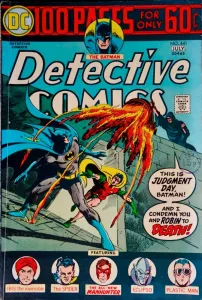
21. Detective Comics #441 –
1st appearance of Harvey Bullock. Harvey makes his brief debut here in July 1974 before vanishing for nearly a decade, finally resurfacing in Batman #361. From that point on, he becomes the rule-bending but fundamentally honorable detective we all know. Jim Aparo provides a molten-metal cover that feels more intense than most Bat-titles of the era. This is also one of DC’s 100-page giants—created for the same reason Marvel experimented with Giant-Size issues: inflation demanded more pages for a higher price.
22. Giant-Size Man-Thing #1 –
The Bronze Age’s most unintentionally giggle-inducing title. It’s still amazing that Giant-Size Man-Thing made it past editors and the Comics Code Authority without anyone raising an eyebrow. According to the CGC census, 14 copies have been graded 9.8 and another 43 have earned a 9.6, making high-grade examples surprisingly scarce. If you own a sharp copy, by all means—encase your Giant-Size Man-Thing in plastic. I couldn’t resist.
23. Marvel Premiere #16 –
2nd appearance of Iron Fist. Another Gil Kane cover lands on the list, though this one has an odd quirk: Iron Fist has turned his back on someone wielding a scythe and appears to be punching the concrete instead. Everything else on the cover works, but the main action is baffling and delightfully weird. Still, it’s an important second appearance and an essential part of Iron Fist’s origin arc.
24. Giant-Size Super-Stars #1 –
Thing vs. Hulk. Let superheroes race each other or fight each other, and every kid in town wants a copy. Marvel and Rich Buckler knew what they were doing with this issue. According to the CGC census, there have been 26 copies of this book graded 9.8 and 68 copies graded 9.6.
25. Adventure into Fear #20 –
1st Morbius in his own title. This issue marks Morbius’s transition from supporting player to headliner, giving him the spotlight in his own feature for the first time. It also includes the debut published artwork of Paul Gulacy, who would go on to become one of Marvel’s most distinctive artists. And yes—another Gil Kane cover. His run in 1973 and 1974 was simply legendary.
If the early ’70s taught us anything, it’s that comics grow up fast. And nowhere is that clearer than in 1974, a year when distrust in government spilled directly onto the page. Watergate gave readers a world where heroes questioned institutions—and in turn, comics introduced a new breed of character: the anti-hero. Wolverine, Punisher, Deathlok, and even Steve Rogers himself, who abandoned the Captain America identity to become Nomad, all reflected a country wrestling with its own ideals. First appearances hit the stands like a freight train, while Marvel’s Giant-Size experiment delivered bigger stories at bigger prices, mirroring the economic upheaval of the oil crisis.
And running through the year was a strong vein of Gothic horror—Dracula, Werewolf by Night, Morbius, Blade, and even House of Secrets muscled their way into the Top 25. Taken together, these books capture a medium in transition, embracing darker themes, experimental formats, and complicated new characters shaped directly by the world around them.
by Ron Cloer
For all the years, see the
Hi Ron! I’ve got 22 of them. Great read, again, thanks!
22 out of 25 is impressive! Are there any that you want to add to your collection?