1972: The Gothic Horror Revival at its Peak
If 1971 opened the door to the supernatural, 1972 stormed straight through it—into the creaky halls of a haunted mansion. In the wake of the Comics Code revisions the year before, both Marvel and DC dove headfirst into the Gothic revival. Within a single twelve-month stretch, readers saw an unprecedented surge of new horror titles.
Marvel seized the moment with a flood of new series — Tomb of Dracula, Werewolf by Night, Chamber of Chills, and Supernatural Thrillers — each steeped in classic horror atmosphere. But DC was no bystander; its answer came through mood and tone rather than monsters. Swamp Thing emerged from the murky depths of House of Secrets, giving horror a tragic, literary dimension. Weird War Tales twisted battlefield heroics into ghost stories, and the scarred gunslinger of All-Star Western #10, Jonah Hex, brought a haunting Gothic sensibility to the Western genre.
 Each of these books signaled a creative and tonal shift — away from costumed crime-fighters and toward fog-shrouded castles, moonlit transformations, and doomed protagonists. The era’s best artists, from Wrightson and Adams to Kane and Kirby, gave horror a newfound elegance. 1972 wasn’t just a year of scary stories; it was the moment the Bronze Age embraced the macabre as high art.
While monsters and mystery ruled the spinner racks, superheroes adapted as well — Luke Cage broke barriers in Hero for Hire, Ghost Rider blazed across Marvel Spotlight #5, and Neal Adams turned Batman into a mythic detective once more. The result was a lineup that perfectly captured 1972’s creative diversity: equal parts fear, fantasy, and experimentation.
Here are the most significant and valuable comics that defined 1972 — a year when darkness, imagination, and innovation shared the same spotlight.
-
Marvel Spotlight #5 –
1st appearance of Ghost Rider (Johnny Blaze). The late 1960s experienced a huge surge in biker movies, such as Easy Rider, and Evel Knievel was jumping 12 cars. Capturing that energy, Johnny Blaze jumped a flaming motorcycle through a gang of thugs. If you were a kid in 1972, this comic book spoke your language. -
Swamp Thing #1 –
1st appearance of Swamp Thing (Alec Holland). The Swamp Thing in House of Secrets #92 is Alex Olsen, so these two are technically different. The first ten issues all feature Bernie Wrightson’s covers and art, paired with the spectacular writing of Len Wein. To me, these are the best ten issues in the Bronze Age. -
All-Star Western #10 –
1st appearance of Jonah Hex. This book blends an Old West setting with a touch of horror. In all the years that CGC has been grading All-Star Western #10, a total of 8 issues have ever been graded 9.8. -
Hero for Hire #1 –
1st appearance of Luke Cage. The poignant thing about Luke Cage was that he was a uniquely Harlem hero. He was an ex-con paid to defend his neighborhood, street by street, with his fists of iron (not Iron Fist—that came later). Some of the language in these books is a little cheesy, but there had to be a starting point. -
The Demon #1 –
1st appearance of Etrigan the Demon. Etrigan is the bridge that connects the Gothic and the superheroic, similar to Swamp Thing or Ghost Rider. 1972 heroes blended the supernatural or paranormal with the superhero genre. This is the title Jack Kirby did after he finished his Fourth World books. -
Marvel Premiere #1 –
1st appearance of Adam Warlock. Before this, he was known as HIM, a being of unchecked power and ego. After receiving the Soul Gem, he gained a mission and apparently a conscience. This book features a great Gil Kane cover showcasing Adam’s power. -
Batman #244 –
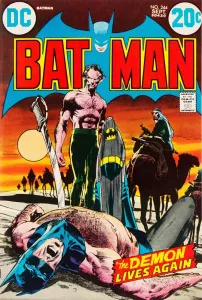
Classic Neal Adams cover. How can you improve on a desert duel with swords, a shirtless display of testosterone between Ra’s al Ghul and the Dark Knight? According to an older interview with Neal Adams, Batman was originally depicted without pants. His editor, Jules Schwartz, made him color Batman’s right leg, and that’s why you see two pairs of pants for Batman. -
Marvel Spotlight #2 –
1st appearance of the Werewolf by Night. Remember that 1971 revision to the CCA guidelines that allowed werewolves? Marvel saw the potential and introduced werewolves, vampires, Frankenstein, and ghouls the following year. -
Action Comics #419 –
1st appearance of the Human Target. There could be some inspiration taken from Sub-Mariner #7 with a partial photo cover. But this is an iconic Neal Adams cover, Superman blasting up through the city skyline. The artwork of Neal’s Superman, mixed with the realism of the photo backdrop, strengthens the believability. -
Avengers #100 –
Centennial issue featuring full team roster. Barry Windsor-Smith drew this great cover and the interior artwork. -
Marvel Team-Up #1 –
Debut of the team-up series. In the previous blog post, we discussed the growing popularity of Spider-Man; this was another way for Marvel to capitalize on it. This series featured Spider-Man teaming up with someone 93 times out of the first 100 issues. -
Amazing Adventures #11 –
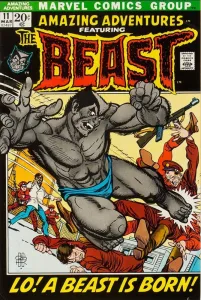
1st appearance of a furry Beast. Before this issue, Beast was a non-hairy ape-like guy with large hands and feet. Gil Kane created this dynamic, tilted-angle action cover, featuring the Beast crushing some guards. The yellow background and orange-clad guards help to accentuate Beast’s new gray fur. -
Night Nurse #1 –
1st appearance of Linda Carter, the Night Nurse. The series would only last four dramatic issues, but it was a grounded non-superhero book. This was Marvel’s attempt to gain female readership with an ethical, everyday hero. -
Tomb of Dracula #1 –
Launch of Marvel’s horror flagship. This title would run for seventy issues, outlasting Werewolf by Night, The Monster Frankenstein, and Chamber of Chills. Neal Adams captures Dracula carrying his gorgeous victim, across a misty, rotting forest with his castle in the distance. Great cover. -
Defenders #1 –
1st ongoing Defenders title. Necrodamus, not Nostrodamus, captured Namor and now seeks to destroy him with a keris dagger. Sal Buscema maintains the creepy, spooky vibe from 1972 with this cover. -
Werewolf by Night #1 –
1st issue of the regular series. Mike Ploog creates this gritty, dirty cover with a bit of humor. My favorite part is the white dog who knows something is about to happen as soon as the werewolf steps out of the shadows. Ploog did the first nine covers and a few others later. Take a look at issue #15 for a fantastic Dracula vs. Werewolf fight. - Batman #241 –
Neal Adams cover. This issue features a new logo for Batman that would remain in use until 1986. Long before Todd McFarlane made Batman’s or Spawn’s cape the centerpiece, Neal Adams did it. - House of Mystery #208 –
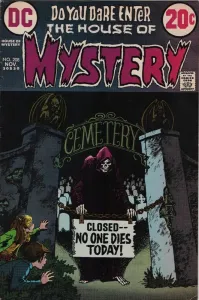
Nick Cardy art; Gothic DC anthology. Death stands guard at the entrance to a cemetery, with inquisitive kids nearby. It’s a haunting cover and one of Nick’s best covers. - Dark Mansion of Forbidden Love #3 –
Iconic gothic title. This isn’t a common comic book on most top comic lists, but the value and styling make it a must-have. Jeff Jones created this mysterious cover with a young woman fleeing a dark figure. -
Kamandi, The Last Boy on Earth #1 –
Kirby’s post-apocalyptic “Last Boy on Earth” debut. Kirby created this fantastic Statue of Liberty cover four years after the Planet of the Apes epic final Statue of Liberty reveal. That doesn’t take away from the power of this post-apocalyptic masterpiece. -
Supernatural Thrillers #1 –
Jim Steranko cover: 1st appearance of It. Steranko is the master of the style. Notice how IT raises its hands defensively above its head as gunmen fire—a classic Steranko composition. The gunmen have wide stances with their weight on one leg. A cloud-shrouded moon with a red night full of bats completes the scene. -
Marvel Premiere #3 –
Doctor Strange’s solo revival after a five-year absence. Writer Stan Lee and artist Barry Windsor-Smith (fresh from Conan the Barbarian) returned the Sorcerer Supreme to psychedelic form—flowing capes, Ditko-style dimensions, and cosmic narration intact. This issue reignited the mystic side of Marvel just as horror and magic were creeping back into the mainstream. - New Gods #7 –
Origin of Darkseid and Orion. “The Pact,” arguably Jack Kirby’s finest single issue of the Fourth World. Here, he reveals the secret origin of Darkseid, Highfather, and the tragic exchange of their sons between New Genesis and Apokolips. Though sales were modest, its mythic grandeur and emotional depth turned this issue into the cornerstone of Kirby’s entire cosmic mythology. Today, it stands as one of DC’s most important Bronze-Age stories. - Harlem Globetrotters #1 –
A cheerful counterbalance to the year’s gloom. Based on the Saturday-morning Hanna-Barbera cartoon, this Gold Key one-shot brought real-world sports icons into comics for younger readers. Its exaggerated tricks, slapstick humor, and wholesome optimism made it a snapshot of early-’70s pop culture—and a reminder that not every 1972 comic involved graveyards and curses. - House of Secrets #100 –
Pure Bernie Wrightson magic. The terror in the eyes of this pale, trembling victim as green ghouls crowd into his personal space is unforgettable. There’s a touch of Saturday-morning nostalgia here too—the ghouls could almost pass for the Creeper from Scooby-Doo, if the stakes weren’t so grim. Wrightson’s early-’70s work has become increasingly sought after, with high-grade copies (9.6 and 9.8) commanding premium prices among collectors.
1972 was the year comics learned to live with their shadows. The horror revival transformed fear into art, Neal Adams and Bernie Wrightson redefined atmosphere, and Jack Kirby proved that myth could live alongside monsters. From the haunted moors of Tomb of Dracula to the cracked streets of Harlem and the blasted ruins of Kamandi, the Bronze Age found its soul in contrast—light and darkness, heroism and tragedy, realism and imagination.
by Ron Cloer
For all the years, see the
I’ve got 19 of the 25 🙂
Nice! That’s awesome